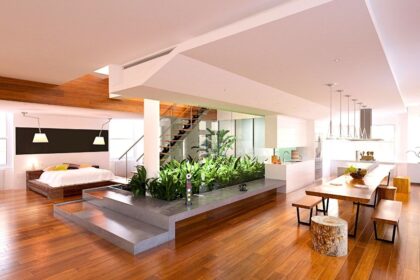


You walk into a house that does everything right.
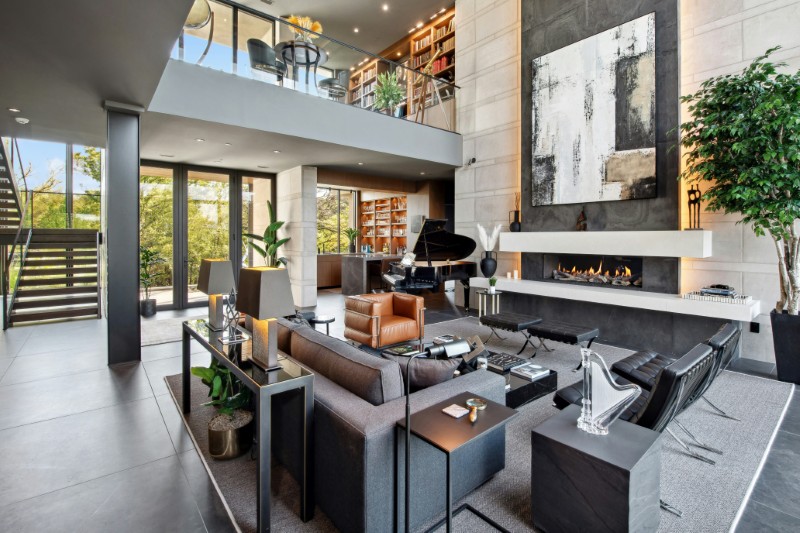
Twenty-foot ceilings, a wall of glass facing the water, honed stone underfoot, a kitchen island cut from a single slab. The listing photos undersold it.
Then the agent starts talking, and her voice comes back off the glass a half second later, thin and hard, and for a moment the room sounds less like a home and more like the lobby of a mid-tier office building.
Nobody writes that down on the showing checklist.
Buyers walk through in forty minutes, mostly in silence, mostly alone in an empty house with a broker who has learned to talk quietly. They notice the light, the finishes, the sight lines. The thing they will actually live with for the next decade, which is how the house behaves when eight people are having dinner in it, never gets tested.
The gap comes down to materials.
Every surface that reads as expensive in a photograph reflects almost all the sound that hits it, and the soft layers that used to compensate have been designed out of the modern interior one by one.
Commercial projects have handled this for decades, with sound absorption written into the specification alongside lighting and HVAC. In luxury residential, acoustic panels and their equivalents show up in the media room and essentially nowhere else.
The materials that photograph well and reflect everything
Look at what the last twenty years of high-end residential design has converged on.
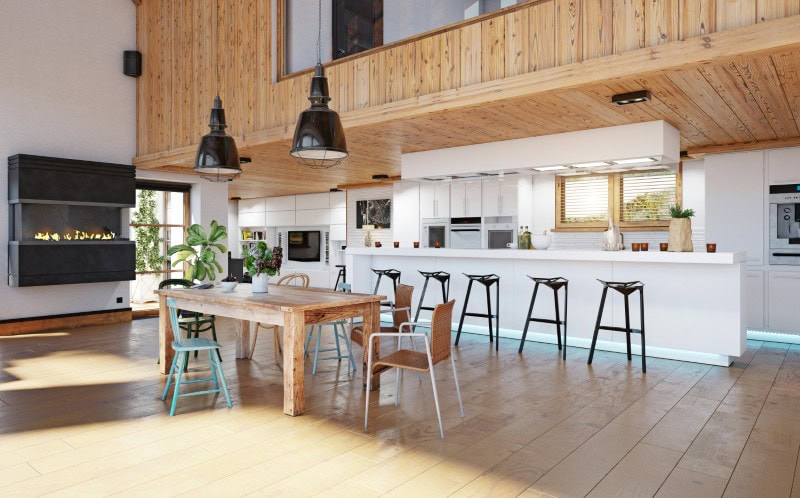
Polished concrete or large-format porcelain instead of carpet. Glass where a wall used to be. Stone counters and stone backsplashes. Flat-panel cabinetry with no relief. Furniture with exposed frames and minimal upholstery. Windows without curtains, because the view is the point and fabric would interrupt it.
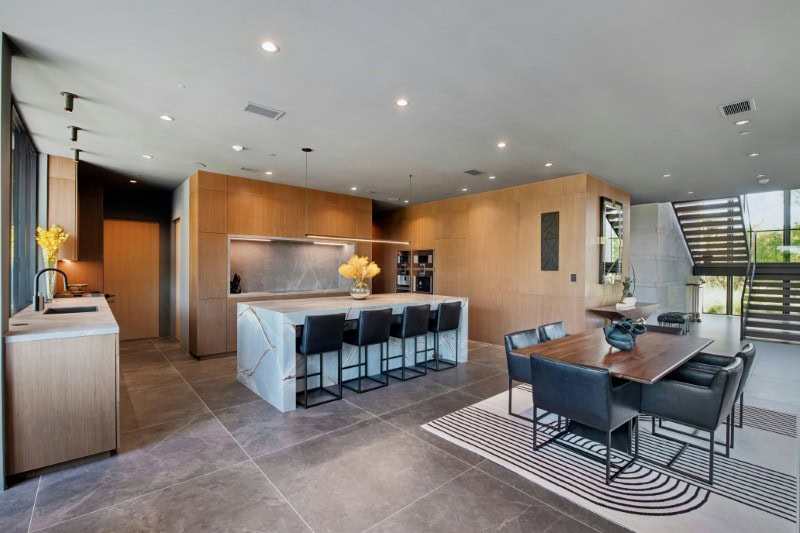
Every one of those choices is defensible on its own terms, and together they produce a room with almost no absorption in it.
Hard, dense, flat surfaces send sound back into the space rather than taking energy out of it. Textiles, upholstery, rugs, and irregular surfaces do the opposite, and they have been steadily eliminated as the aesthetic moved toward restraint.
Older houses solved this without anyone framing it as an acoustic decision. Wall-to-wall carpet, heavy lined drapery, overstuffed sofas, wallpaper, bookshelves loaded with actual books, plaster with texture in it.
That interior was doing acoustic work as a side effect of its own visual language. When the language changed, the side effect went with it, and nothing replaced the function.
What remains is a category of house that looks composed and sounds unfinished. The disconnect is sharpest in exactly the rooms that cost the most to build.
Volume makes it worse, not better
Reverberation is a function of how big the space is and how much of the sound energy gets absorbed rather than reflected.
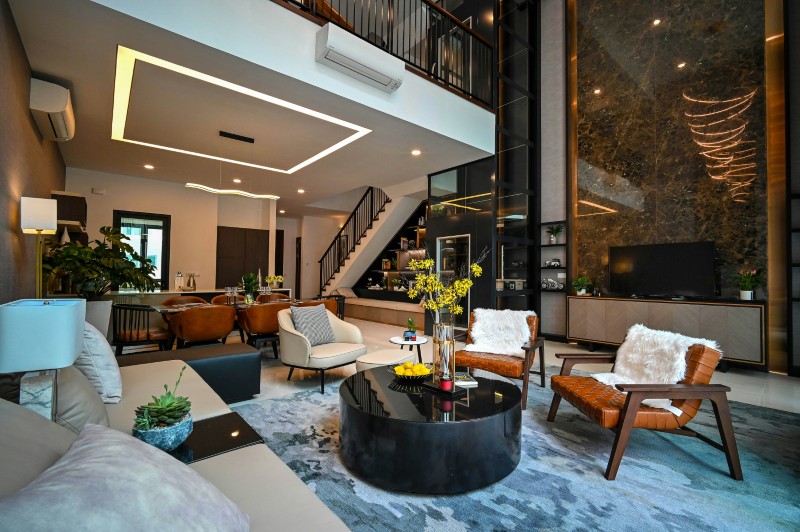
Increase the volume without adding absorption, and the sound takes longer to decay, which is why a double-height great room with a mezzanine sounds harsher than a conventional living room finished in the same materials.
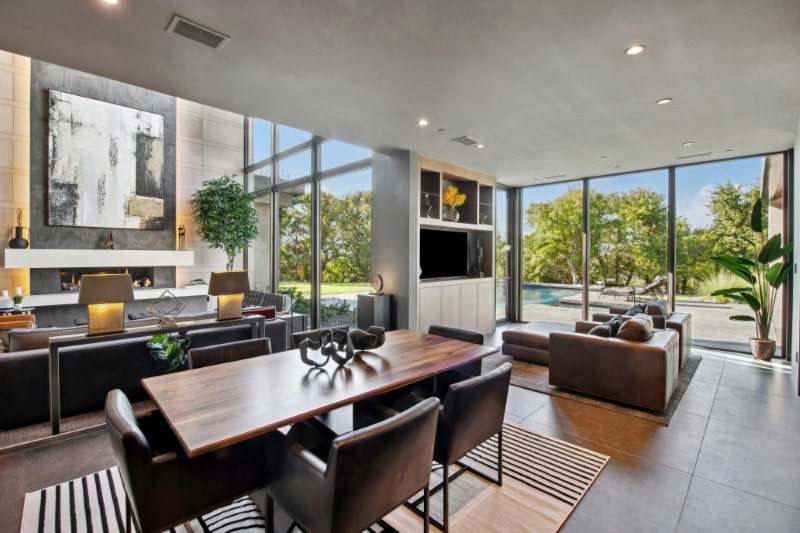
Open plans compound it. When the kitchen, dining area, and living room share one uninterrupted volume, they share one acoustic environment.
The range hood, the dishwasher, the television, and the conversation at the island all occupy the same space with nothing between them. Walls used to do that separating work, and removing them was the entire point of the layout.
Worth separating two problems that get conflated.
Echo and harshness inside a room come from reflections off the room’s own surfaces, and absorption addresses them. Hearing footsteps from the floor above or a conversation through a wall is sound transmitting between spaces, which is a construction issue involving mass and structural isolation.
Panels on a wall do the first job well and the second job barely at all, and buyers who expect otherwise end up disappointed with a product that was working correctly.
What this actually costs you day to day
None of this registers as an acoustic complaint. It registers as a house that is somehow tiring to be in.
Dinner with eight people in a hard-surfaced dining room means everyone raising their voice slightly, then raising it again as the room fills with its own reflections.
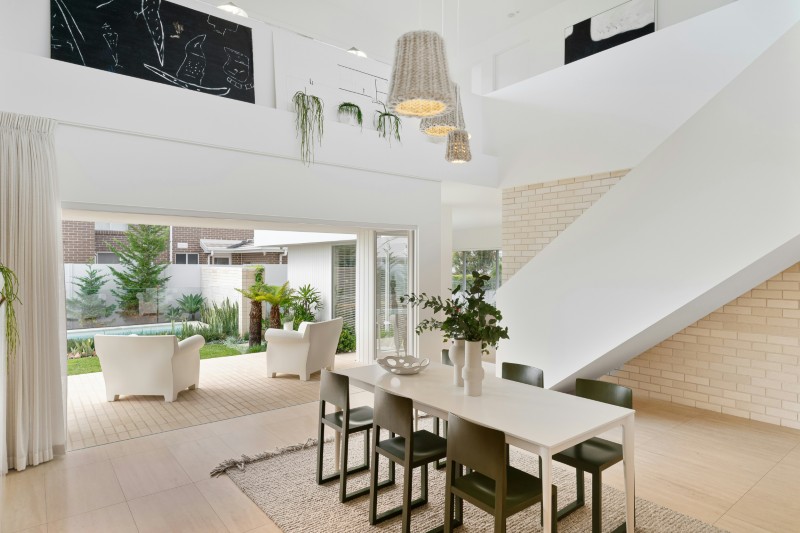
Guests leave with the specific fatigue that comes from two hours of low-level effort to hear and be heard. Hosts start unconsciously seating fewer people.
The media room usually escapes this, because media rooms are the one space where somebody thought about it. The living room with the concrete floor does not, and dialogue on the television stays muddy no matter how far up the volume goes, since raising the level raises the reflections along with it.
Home offices produce the most measurable consequence.
A call taken in a glass-walled study makes you sound like you are broadcasting from a conference room, and that impression is now part of how colleagues and clients read you several times a week.
Add children, a dog, and a hard-floored open plan, and the ground floor develops a permanent background of sound that never fully settles. Owners describe the result as the house feeling restless. They rarely connect it to the finishes they chose.
How the industry already solved this issue
Acoustic performance is a mature discipline with established targets, and nearly every building type that cares about sound has them.
| Space Type | Typical Reverberation Target | What It Optimizes For |
| Concert hall | Roughly 1.8 to 2.2 seconds | Fullness and blend for orchestral music |
| Opera house | Roughly 1.3 to 1.8 seconds | Voice clarity over an orchestra |
| Classroom | 0.6 seconds or below under ANSI/ASA S12.60 | Speech intelligibility for every seat |
| Restaurant, upper tier | Roughly 0.5 to 0.8 seconds | Conversation at a table without shouting |
| Recording studio | Under 0.3 seconds | A clean signal with no room character |
| Private residence | No published standard | Nothing in particular |
That last row is the point. A public school classroom in the United States has a legally referenced ceiling on reverberation time. A twelve-thousand-square-foot house has none, and the specification process that governs every other system in the building simply skips this one.
Media rooms are the exception that proves it. Owners building a dedicated screening space accept without argument that the room needs treatment, because the failure would be obvious and immediate.
The same owners spend far more waking hours in the great room, which gets treated as a purely visual composition.
Treatment that doesn’t look like treatment
The objection is aesthetic, and it is a fair one. Nobody spending seven figures on interiors wants gray foam rectangles bolted to a wall.
- Printed and art-wrapped panels read as framed artwork and carry any image the owner supplies, so the acoustic function is invisible.
- Panels wrapped in the interior’s own textiles disappear into a scheme when the fabric matches the drapery or upholstery already specified.
- Wood slat walls over an absorptive backing have become a design feature in their own right and perform acoustic work while doing it.
- Ceiling clouds above a dining table or seating group take the largest reflective surface out of play and read as an architectural gesture.
- Perforated panels or micro-slotted millwork with absorption behind hide the function entirely inside the finish carpentry.
- Rugs, lined drapery, and upholstered pieces remain the first and least intrusive layer, and in a lightly reverberant room they may be enough on their own.
Done well, none of it announces itself. The room simply sounds settled, and visitors register it as a quality they cannot name.
The thing to listen for at a showing
Two tests take thirty seconds, and neither requires equipment.
Stand in the middle of the largest room and clap once. In a room with a normal amount of absorption, the sound stops almost immediately.
If you hear a bright ring trailing behind the clap, or a rapid stutter bouncing between parallel walls, the room is telling you what dinner will sound like. Then walk to one end and have someone speak from the other end at a conversational level.
Difficulty following them in an empty room means real difficulty following them with a dozen people present.
Timing changes what a fix costs. Treatment planned during construction disappears into the millwork and the ceiling detail.
The same work in a finished house means surface-mounted solutions, which suppliers like Sound Pro Solutions build in custom sizes, printed finishes, and the buyer’s own fabric for exactly this reason. Both work. One is invisible, and one has to be designed to be seen.
Houses get evaluated by eye in under an hour and then lived in by ear for years, and the second experience is the one that determines whether an expensive house ever comes to feel like a good one.
More stories
17 quiet design choices that signal real quality
Why some expensive homes don’t feel luxurious at all
Expert reveals the one color you should never paint your walls (and why)